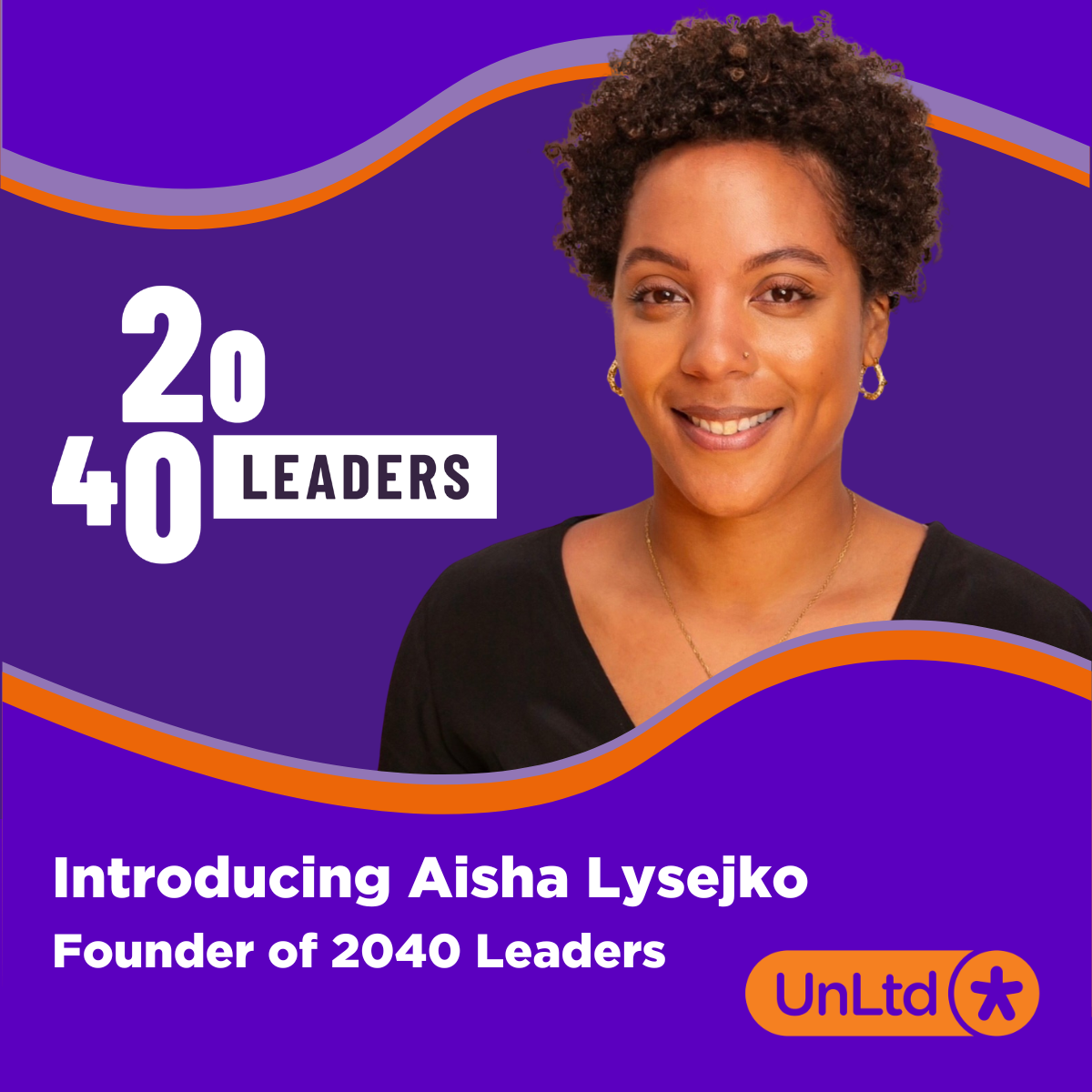
Introducing Aisha Lysejko, founder of 2040 Leaders
Closing the gap between access to work and career success for young professionals.
By Nicola Curtis, Head of External Affairs
Getting a foot in the door is not always the hardest part of starting a career. It is knowing how to stay, grow and succeed once you are there.
Over more than a decade working in social impact, Aisha Lysejko saw how much energy goes into helping young people access opportunities, and how little support often exists once they arrive in professional environments.
As the founder of 2040 Leaders, Aisha works with employers and young professionals to address a challenge that has been debated across the business community for decades. Employer organisations have consistently highlighted concerns about “work readiness” among school and college leavers.
However, through working directly with employers and early career professionals, Aisha has seen how often workplace challenges are linked to unspoken expectations, differences in lived experience and gaps in communication between generations.
“We do a lot of work getting a young person into a job,” she said. “But we kind of feel like the job is done once they’re there. Actually, it’s day one when they start their job, where all the challenges really start.”
Aisha’s route into this work was shaped by her own experience of navigating professional spaces. The former barrister became a parent at 19 while completing her professional legal qualifications.
“I look back, and I think that actually was impressive,” she said. “But at the time, if you are not what is expected in terms of a middle-class professional and having a very specific background in life, you are made to feel like you are not good enough. I was told things like, ‘Don't tell anybody that you've got a child. You're already Black, you're already a woman, you're from a working-class background. Don't also add on top of it that you're a young parent.’”
The experience drew her towards the social impact sector. For five years, she worked at a charity supporting young people into professional careers and working directly with employers to examine structural barriers.
“That was full circle for me,” she said. “To support young people into those careers, but also talk to employers and say, ‘This is what you’re doing wrong. These are the barriers you are creating.’”
Across the employability and social mobility space, she believes there has been real progress in helping young people access professional opportunities. What she saw far less consistently was structured support once those young people arrived in the workplace.
That insight became the foundation for 2040 Leaders.
The not-for-profit organisation, started in 2024, focuses on the knowledge and expectations that sit beneath formal job descriptions. Many young people, particularly those from underrepresented or non-traditional backgrounds, enter professional environments without access to the informal knowledge others may have picked up through family or social networks. At the same time, managers often assume shared understanding around expectations, communication and workplace norms.
The result can be misinterpretation on both sides.
Aisha worked with an organisation experiencing difficulties with an apprentice cohort. Managers believed young employees lacked engagement and basic professional skills, such as time management. The apprentices, however, had moved straight from education into work and were interpreting the manager relationship through a school-based lens. They were not intentionally disengaged. They did not fully understand the expectations being placed on them.
Once both groups were brought together to discuss expectations, working styles and communication openly, the change was noticeable. Managers reported stronger engagement and more openness to feedback. Apprentices described feeling more confident approaching their managers and clearer about what was expected of them.
“They just didn’t understand each other’s worlds,” Aisha said.
2040 Leaders delivers this work through three connected areas. The first supports young people to understand how professional environments operate in practice. The second works with managers to build confidence and capability in supporting early career professionals, particularly those from underrepresented backgrounds. The third brings both groups together to build working relationships directly, focusing on values, working styles, expectations and feedback.
At the centre of this is Aisha’s focus on human connection within professional environments.
“My mission is to centre human connection as a foundation for thriving careers,” she said. “We need to ensure young people and their managers are equipped with the human skills, knowledge and relationships needed to successfully navigate the workplace and lead change.”
The name 2040 Leaders reflects her focus on the future. She believes today’s early career professionals will be leading organisations and communities through significant global challenges, from technological change to climate pressures and geopolitical instability by 2040. Supporting their development now has implications far beyond individual careers.
Alongside direct delivery with employers, Aisha also works with universities, schools and sector organisations to encourage a broader shift in how employability is understood. She advocates for a stronger focus on how people succeed and progress once they are in work, not just how they access opportunities.
Her work also includes building an intergenerational professional community designed to reduce isolation and create spaces where people can share experiences of navigating workplace challenges across different career stages.
UnLtd has supported Aisha’s work from the beginning, with grant funding of £20,500 and an extensive package of personalised support. Currently part of our Systems Change programme, delivered in partnership with the Henry Smith Foundation, Aisha is now thinking differently about her work and where it sits within the wider employment landscape.
As a solo founder, building a social enterprise can feel isolating, particularly when working on complex social challenges.
“This work is hard,” she said. “Business is hard. Working in the social impact sector is hard. Being around people who understand the challenges you are facing, and who are trying to solve problems at that level as well, makes a huge difference.”
Working alongside other social entrepreneurs tackling different parts of the system has helped her see how collective action can shift outcomes at scale.
“We said, as a group, that if we plotted what we were all doing on a map, it would be incredible to see how we are collectively shaping the system,” she said.
For Aisha, that sense of shared purpose has been one of the most powerful parts of the experience. It has opened up opportunities to collaborate with other founders, learn from different approaches and stay connected to a community of people working towards similar long-term goals.
“I think one of the best things about UnLtd is the community,” she said. “Being around people who are values aligned, who share that mission, and who are doing really incredible things, that is really powerful.”