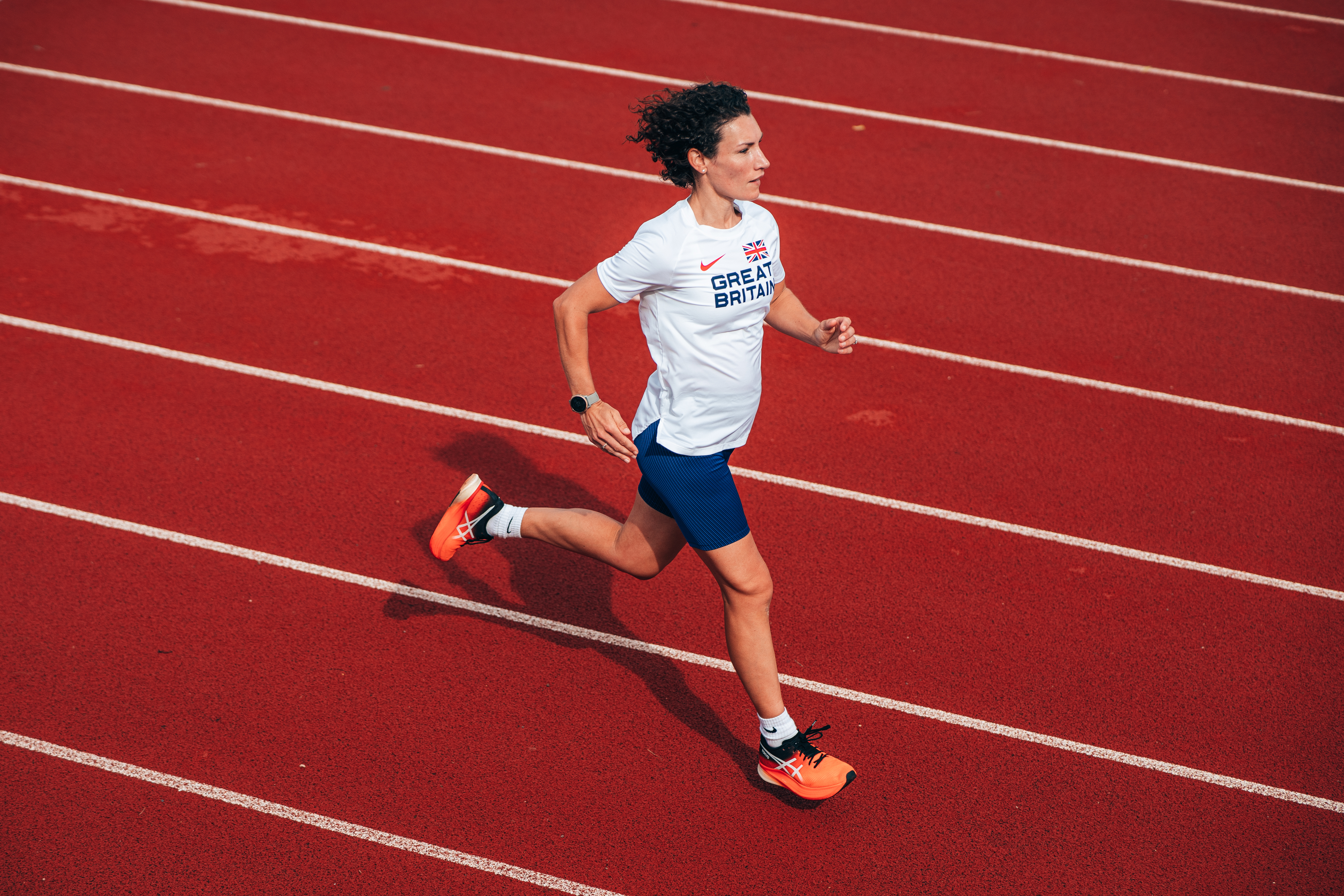
Introducing Sophie Power, founder of SheRACES
Making sport work for women, race by race and beyond.
By Nicola Curtis, Head of External Affairs
In 2018, a photograph of Sophie Power stopped people mid-scroll. She was 56 miles into the UTMB - a 106-mile mountain ultramarathon through the Alps - sitting at a rest station, breastfeeding her three-month-old son Cormac. The image went around the world.
“The photo has got nothing to do with me anymore,” she said. “It is a metaphor for motherhood. I get messages from a German midwife saying it is on the wall in their waiting room. It is in museums.”
Sophie had wanted to defer her place that year while she recovered from childbirth. UTMB would defer entries for injury. Pregnancy, as far as the organisation was concerned, was not in the same category. Having already lost a hard-won qualifying place when pregnant with her first son, she chose to race rather than forfeit it again. Most women in that position simply walk away.
The response to the photograph was not what she expected. Other race directors wrote to her, embarrassed.
"They said, we just didn’t think about this. We have a policy on our website that says no deferrals for whatever reason. We assumed women would contact us if they needed a pregnancy deferral.” What she had to explain, however, was that women often don’t ask. “If you go to event organisers and ask who asks to break the rules, it’s always men.”
She challenged UTMB directly. They changed their policy.
What could have remained one athlete, one issue, one race instead became SheRACES.
“It wasn’t about just pregnancy,” she said. “This is about being a woman. This is how sport is not designed through a female lens. In order to try and start changing things, I needed to do some research and create a framework. It wasn’t about me anymore. It was about women, the barriers we face.”
Those barriers run deeper than deferral policies.
“We’re physiologically different, and sport needs to expect that,” she said. “We have periods, we get pregnant, we have menopause, we are slightly slower on average, we’re physically smaller.
“At the age of five, a girl thinks that boys are better at sport than she is - and the boys think that too. At the age of two, girls have less outdoor time than boys. Society is building this barrier in.”
When she looked specifically at how this shows up in race design, the issues were everywhere. Language that uses toughness as a selling point works for men and puts women off. Cut-off times set to a male average pace tacitly exclude slower runners - a group that skews female. Start-line imagery almost always shows the fast men who pushed to the front.
She saw this clearly in her work with the Abingdon Marathon where even the promotional imagery had been putting women off entering. Two years on, two thirds more women were on the start line.
“Some very simple changes were made, and one of them was imagery,” she said.
SheRACES works with race directors, event sponsors, and athletes directly. Its race guidelines, free to download, set out what any event can do to ensure women are genuinely included - pregnancy deferral policies, toilet provision, changing facilities, equal prize money, inclusive communications.
Brands control significant resources in the events industry, and SheRACES Enable Inclusion campaign asked them to use them by committing to only sponsor races that meet minimum standards for female inclusion.
The commercial case is convincing.
“We had a big piece of work with Threshold Sports. We are very grateful to them for opening up their books and now we can say this is how many more people we got, this is what we did. We have that commercial analysis.”
Research shows 88% of women would be more likely to sign up for an event that was clearly inclusive.
“You just put that to event organisers and they go, ‘Oh yeah, actually, maybe I should do this stuff, because I’ll get more people.’”
She is also clear about why events are where SheRACES focuses its energy, rather than, for example, childcare policy or workplace culture.
“I can’t make dads do more childcare easily. I can’t change the available time for women. But I can change events, because I’m going to a small number of people, I am going to people with commercial concerns that I can talk to. That is more impactful for my time.”
However, there is still resistance. Most race directors genuinely didn’t know there were issues. Some were already doing the right things quietly and just needed to say so out loud. A large group is ready to be told how. Then there are what she calls the dinosaurs.
“Sadly, I count the London Marathon in that. The fight to get that pregnancy policy change took so much energy and effort. It shouldn’t have done. Some of their language to us was unacceptable.”
A male executive there, she recalled, told her: “I know what it’s like to get back from having babies. I’ve seen my wife do it twice.”
The London Marathon has since signed up to the Brighton Plus Helsinki Declaration, committing to equity for women in sport. And yet gaps remain. A woman who becomes pregnant still pays twice for a deferral, and for all their other events outside the marathon, no pregnancy deferral exists at all.
“It’s gender washing,” said Sophie. “I’m trying to solve it behind the scenes, but this is where we have to point these things out.”
She also encounters resistance from an unexpected quarter - women who have come through the sport on hard terms and are wary of anything that looks like special treatment.
“They say, ‘We don’t want you to make us look like we need the help, don’t make it easier.’ We’re not making events any easier. An Ironman doesn’t get any easier in distance because they put pregnancy deferrals in, or they have a female-only race start so you don’t get swum over. The events don’t get any easier. But we are making sure that more women can take part.”
Since SheRACES began its work, an estimated 3,000 women have taken up pregnancy deferrals at the London Marathon alone.
“We think we’ve probably affected a million women on start lines. Every one of those deferrals is a story of a mum who got back to a start line. I get all the messages in my inbox and it’s such an honour. I know how it feels, because it was me.”
SheRACES’ most recently accredited race is the Hyderabad marathon - the second biggest marathon in India - and chapters are opening in the US, with more volunteers coming forward to lead them.
The organisation is built to scale without a heavy overhead: a small paid team, a large volunteer network, with accreditation fees reinvested directly. Sophie volunteers her own time as founder and CEO.
An £18,000 Movement for Change Scaling Up Award from UnLtd, received across 2025/26, has been significant in enabling this growth.
“It gave me the confidence to hire an additional freelancer – that is going to change the organisation immeasurably. We wouldn’t have been able to do the research we have done this year without that funding.”
Her support manager Victor has been a consistent presence through the process of building the organisation.
“Having the people to talk to, advice on the legal side, helping me think through structures - and being immersed in that world alongside other social entrepreneurs, seeing how they’ve navigated the system, is really helpful.”
SheRACES is not just about running.
“It is about society. Sport is a very powerful lens for people to understand that women are designed differently to men, and that to function and to perform optimally, we sometimes need things to look different.”
Brentford Football Club saw what SheRACES was doing with race events and applied the thinking to its own policies. It reviewed its season ticket maternity approach, recognising that mothers might not want to return quickly after having a baby, and now stocks period products in all its female toilets.
Sophie’s longer-term ambition is that SheRACES does not have to exist at all:
“This week I was talking with the head of British Cycling and with the head of running at World Athletics. My goal is that every sport, every event is designed through a female lens, and that is the norm, and people don’t think twice about it.”
She has three children - two sons and a daughter who was a year old when SheRACES formally launched in 2022.
“My goal is for Saoirse to be a teenager and look at me and say, what have you been wasting your time on, Mum? There are no barriers for me. What did you even do?”
SheRACES’ fundraising trail event - the SheRACES Trail Series - takes place on Sunday 5 July in the Surrey Hills, with 10k, 25k and 50k distances, no cut-offs, and walkers as welcome as runners. Find out more at sheracestrailseries.com